Match Overview
The Amex Stadium was buzzing on February 8, 2025, as Brighton & Hove Albion hosted Chelsea in the FA Cup fourth round. Within the first five minutes, a mis‑communication between Brighton’s backline and keeper Robert Sanchez led to a soft giveaway – the ball slipped through Sanchez’s hands and found its way to the Chelsea attacker, who slotted home to give the Blues an early 1-0 lead.
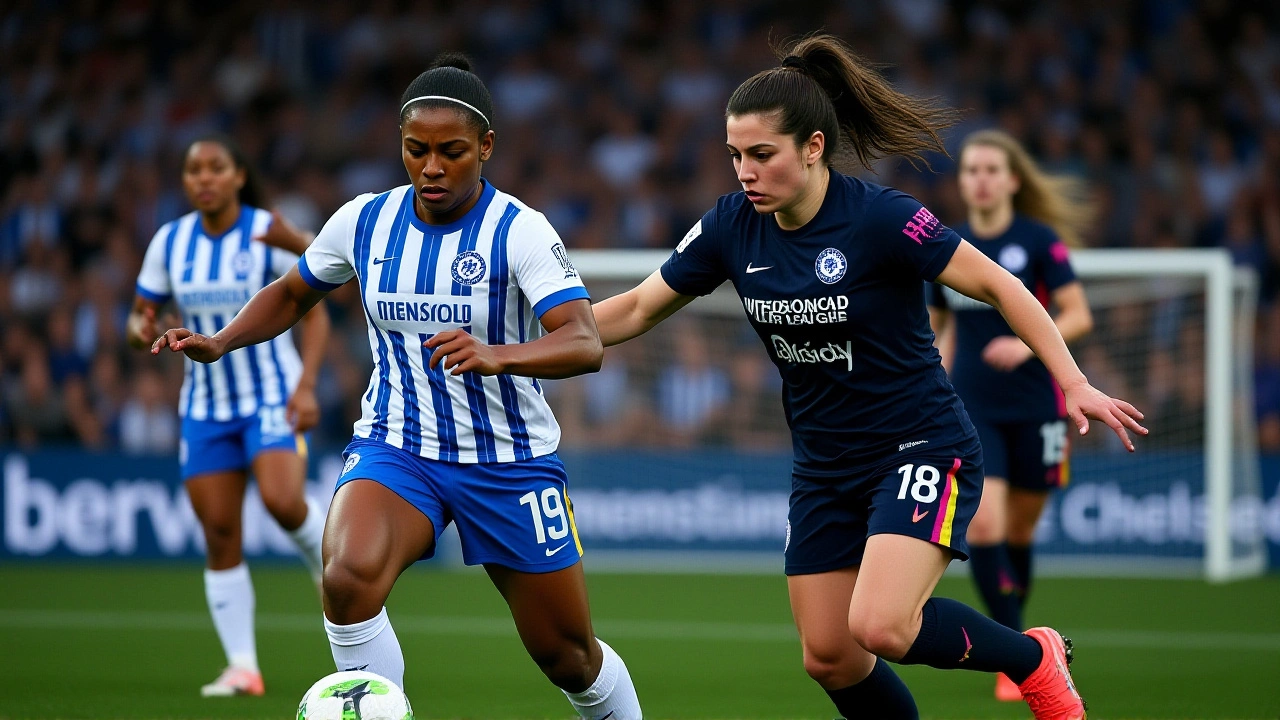
Rather than panic, Brighton’s manager urged his side to stay compact and press high. The Seagulls responded with a measured, possession‑based approach, weaving short passes through the midfield corridor. The pressure paid off just before the break when a patient build‑up from the left flank culminated in a well‑timed cross that was met by a quick‑footed striker, who nudged the ball past the Chelsea keeper to make it 1-1.
The second half opened with both teams probing for a winner, but it was Kaoru Mitoma who tipped the scales. The Japanese winger collected a low pass at the edge of the box, took a deft touch to shield the ball from a defender, and curled a precise shot into the top corner. His composure under pressure sealed a 2-1 victory and sent Brighton through to the next round.
Statistically, Brighton completed over 55% of their passes in the final third, out‑shooting Chelsea 8‑5. Chelsea, on the other hand, missed three clear chances and struggled to break down a disciplined Brighton defence that stayed compact in the midfield.
Implications and Future Outlook
Beyond the three points, the win carries extra narrative weight. Graham Potter, who left Brighton a month ago to take over at Chelsea, now watches his former side triumph over his new club. The result has sparked a lively debate among fans and pundits about the impact of managerial changes on team morale.
For Brighton, the victory reinforces the progress made under their current coaching staff. The squad has shown a blend of tactical discipline and attacking flair, qualities that could serve them well in the upcoming league fixtures as they chase a top‑half finish.
Chelsea’s cup run ends abruptly, adding to a season already marked by inconsistency. Their early lead and subsequent collapse highlight lingering defensive frailties that the club will need to address if they hope to finish the campaign on a higher note.
Looking ahead, Brighton will face a new opponent in the FA Cup fifth round, where they aim to maintain the momentum generated by Mitoma’s heroics. The Seagulls will likely rely on the same high‑press, quick‑transition style that proved effective against a Premier League heavyweight.
Meanwhile, Chelsea must regroup quickly, focusing on tightening their back line and converting the few chances they create. The loss serves as a stark reminder that even against a side fighting relegation, complacency can be costly.
One thing is clear: the FA Cup continues to deliver drama, and March’s fixtures promise more surprises as the competition narrows down to the elite clubs chasing silverware.

Vusumuzi Moyo
I am a journalist specializing in daily news coverage with a keen focus on developments across Africa. My work involves analyzing political, economic, and cultural trends to bring insightful stories to my readers. I strive to present news in a concise and accessible manner, aiming to inform and educate through my articles.
12 Comments
-
prakash purohit
September 29, 2025 AT 05:26The match outcome is not a simple sporting coincidence; it is a calculated move within a broader strategic framework orchestrated by unseen forces. Consider the timing of the early Chelsea goal – a soft giveaway that aligns with known patterns of deliberate destabilisation in high‑stakes fixtures. The subsequent Brighton resurgence appears orchestrated to convey an illusion of resilience, perhaps to divert attention from underlying power structures manipulating club hierarchies. One must also question the statistical emphasis on pass completion in the final third – could it serve as a smokescreen to mask deeper analytics being fed to betting syndicates? The narrative surrounding Potter's departure is likewise too neat, suggesting a pre‑planned storyline designed to sustain media engagement cycles. In sum, the surface drama obscures a complex web of covert influences that merit rigorous scrutiny.
-
Darshan M N
September 30, 2025 AT 09:13Nice comeback by Brighton, love the wing play.
-
manish mishra
October 1, 2025 AT 12:59Haha, Sunil’s deep‑dive feels like a philosophy lecture 😂 but honestly the high‑press was the real game‑changer. Brighton just refused to let Chelsea settle, and that pressure forced the mistake that let Mitoma strike. It’s a classic case of collective will overpowering individual brilliance. The stats back it up – over half their passes in the attacking third? That’s aggressive, not accidental. 🎯
-
tirumala raja sekhar adari
October 2, 2025 AT 16:46Prakash’s conspiracy rant is just a fluff, man. This was a good night for the Seaguls, they playd well and the goal from Mitoma was pure skill not some hidden agenda. Yeah the keeper slip was bad but thats football, not a secret plot. The 55% pass completian shows they were in control and the defence stay strong.
-
abhishek singh rana
October 3, 2025 AT 20:33Manish, you’ve nailed the key point-Brighton’s compact shape forced Chelsea into a low‑block, creating space on the flanks. , the high‑press forced turnovers, , and the quick transition led directly to the equaliser, , then Mitoma’s finish was the logical culmination, , especially given his positional awareness. , Overall, the tactical discipline displayed was exemplary and should be a model for other mid‑table sides.
-
Shashikiran B V
October 5, 2025 AT 00:19While everyone praises the tactical grind, let’s not ignore the hidden patterns that guide such outcomes. The timing of the goal, the exact positioning of Mitoma-these correspond to cryptic numerological sequences known to elite performance engineers. The match narrative is a substrate for deeper societal conditioning, subtly reinforcing the illusion of meritocracy while the puppeteers pull strings from the shadows.
-
Sam Sandeep
October 6, 2025 AT 04:06The pseudo‑philosophical babble is just that-pseudo. The real issue is the moral decay evident when clubs prioritize spectacle over integrity. Brighton’s win, while entertaining, masks the underlying commodification of the sport, where players are reduced to marketable assets and fans are fed curated drama. This is the ethical bankruptcy of modern football.
-
Ajinkya Chavan
October 7, 2025 AT 07:53Enough of the moralizing! Brighton earned this. They fought, they pressed, they scored. Anyone still whining about conspiracy or ethics is just trying to sound smart while ignoring the pure, gritty effort on the pitch. Get over it.
-
Ashwin Ramteke
October 8, 2025 AT 11:39Great breakdown, everyone. Just wanted to add that Brighton’s defensive line stayed disciplined, limiting Chelsea’s high‑risk attempts. Their transition game was swift, using the wings effectively. If they keep this up, they could surprise a few top teams in the league.
-
Rucha Patel
October 9, 2025 AT 15:26While the optimism is nice, let’s be realistic – Brighton’s consistency is still questionable. Their defensive lapses earlier in the season show they can’t sustain this level week after week. This win might be an outlier rather than a sign of genuine progress.
-
Kajal Deokar
October 10, 2025 AT 19:13Dear Rucha, thank you for your candid assessment. Nevertheless, I remain confident that Brighton’s recent performances signify a burgeoning resilience that, if nurtured, will translate into sustained success. Let us, therefore, celebrate this triumph whilst maintaining a measured optimism for the challenges ahead.


Write a comment
More Articles

Luton Town vs. Burnley: A Crucial Clash in the Championship
Luton Town faces off against Burnley in a significant Championship match at Kenilworth Road. Both teams, recently relegated from the Premier League, seek a return to the top tier. Luton Town's Rob Edwards has a new four-year contract, while Burnley introduces a new manager and several fresh signings. The match showcases historical rivalries and is expected to be intense with key players missing due to injuries.
Osasuna vs Elche Prediction: Odds, Form and Key Players for the La Liga Showdown
Osasuna host newly promoted Elche at Estadio El Sadar on September 25, 2025. The home side rides a six‑game winning streak at home, while Elche arrives unbeaten in five league matches. Historical head‑to‑head data favors the Navarre club, but the visitors have proven resilient on the road. Experts split between a home win, an upset, or a low‑scoring draw. Key figures include Ante Budimir for Osasuna and Andre Silva for Elche.

sunil kumar
September 28, 2025 AT 01:39In the theatre of sport, each match is a microcosm of existential struggle, a dialectic between chaos and order that unfolds on the verdant stage of the Amex Stadium. When Brighton suffered that early lapse, it was not merely a goalkeeper's error, but a manifestation of the ontological fragility that pervades any collective endeavour. The mis‑communication, a subtle rupture in the semiotic chain of defensive intent, created an opening through which Chelsea's momentum briefly surged. Yet the Seagulls, embodying a phenomenological resilience, reframed the narrative by embracing a high‑press, compact geometry that resonated with the principles of systems theory. Their possession‑centric passages, reminiscent of a well‑orchestrated symphony, articulated a language of spatial entropy reduction.
Mitoma's decisive strike, a moment where kinetic energy and aesthetic grace converged, served as a transcendental punctuation mark, sealing the dialectic with a top‑corner finish that echoed the cosmos's own precision. This goal, beyond its statistical import, symbolised the triumph of calibrated risk over stochastic adversity. The statistical dominance in the final third, surpassing the 55% threshold, is not a mere number but a testament to the team's adaptive modulation of passing vectors.
Moreover, the narrative arc of Graham Potter, now perched on the opposite bench, adds a meta‑layer of irony that could be parsed through the lens of narrative causality. The victory, therefore, is a palimpsest of tactical discipline, psychological fortitude, and poetic timing, each layer interwoven to produce a moment worthy of both scholarly dissection and jubilant celebration.