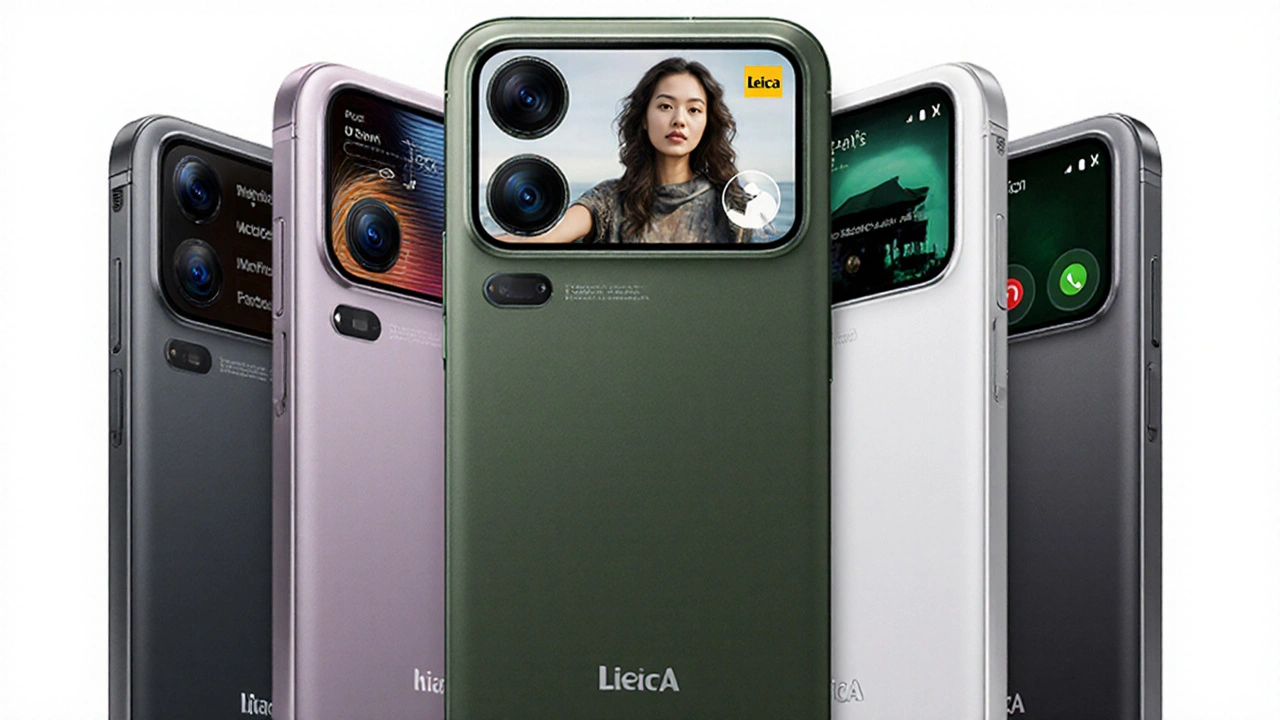
What the Xiaomi 17 series Offers
On September 27, 2025, Xiaomi opened its online store, Mi.com, and official retail outlets for the new 17 lineup. Buyers can choose from three variants – the standard Xiaomi 17, the Xiaomi 17 Pro, and the top‑end Xiaomi 17 Pro Max. All three sport a glass‑back design, an aluminum frame, and a 6.7‑inch AMOLED panel that supports a 120 Hz refresh rate.
Charging is the headline act. Each model supports 100‑watt PPS fast charging, and Xiaomi brands the accompanying battery as an "Ultra‑High Energy Density" cell. In real‑world tests, the Pro Max hits 0 to 100 % in just 22 minutes, a clear win over most competitors that still sit above 30 minutes for a full charge.
Another eye‑catching addition is a secondary back‑screen display that shows notifications, music controls, and quick replies. The screen uses DC dimming technology to cut blue‑light emissions, a nod to eye‑health concerns that have grown louder among heavy smartphone users.
- Processor: Snapdragon 8 Gen 4 (Pro Max) / Snapdragon 8 Gen 3 (Pro) / Snapdragon 8 Gen 2 (standard)
- RAM/Storage: 12 GB/256 GB (standard), 12 GB/512 GB (Pro), 16 GB/1 TB (Pro Max)
- Camera: Triple‑lens setup – 50 MP main, 48 MP ultra‑wide, 12 MP telephoto (Pro Max adds a periscope module)
- Battery: 4600 mAh (standard), 5000 mAh (Pro), 5400 mAh (Pro Max)
- Charging: 100 W wired, 50 W wireless, reverse wireless up to 10 W
- Extras: Charger and cable included, X‑OS 12 with MIUI overlay, Xiaomi Offline Communication feature (OTA from Sep 24)
While many Android flagships have dropped the charger from the box, Xiaomi kept it, positioning the move as a “customer‑first” decision. The company also rolled out a new OTA update called Offline Communication, which lets devices exchange encrypted messages without relying on cellular data – a feature that may appeal to privacy‑concerned users.
How It Stacks Up Against the Competition
The timing is unmistakable: Apple’s iPhone 17 series is already on the market, and Samsung’s Galaxy S17 line is expected later this year. Xiaomi’s pricing strategy undercuts both rivals – the Pro Max starts at $899, roughly $200 less than the iPhone 17 Pro Max’s launch price.
Design-wise, eyebrows have been raised. The rectangular camera island, rounded edges, and matte finish mirror Apple’s recent aesthetic, prompting some observers to call it a “copycat” move. Even the decision to skip a "16" designation and jump straight to "17" looks like a deliberate alignment with Apple’s naming cadence.
Analysts say the design debate won’t dent sales among Android users hungry for premium specs at lower cost. However, the iOS‑loyal crowd is unlikely to switch without a compelling ecosystem pull, and Xiaomi’s MIUI still carries a fair amount of bloatware compared to stock Android.
Early reviewer sentiment reflects this split. Hardware scores are high – reviewers praise the fluid display, lightning‑fast charging, and versatile camera system. Software impressions are more mixed; critics point to delayed security patches and a heavy skin that can feel sluggish on lower‑end configurations.
Service expectations also surface. Xiaomi’s after‑sales network is still expanding in Western markets, and some users report longer repair turnaround times compared to Apple’s Genius Bar or Samsung’s Care+ program.
Despite these hurdles, the 17 series arms Xiaomi with a solid foothold in the premium arena. By delivering flagship‑level performance at a more approachable price point, it forces other Android manufacturers to rethink their value propositions. If the hardware continues to impress and software updates become more reliable, the series could reshape the high‑end smartphone battle line, offering a viable Android alternative for consumers who admire the iPhone’s look but prefer a different operating system.

Vusumuzi Moyo
I am a journalist specializing in daily news coverage with a keen focus on developments across Africa. My work involves analyzing political, economic, and cultural trends to bring insightful stories to my readers. I strive to present news in a concise and accessible manner, aiming to inform and educate through my articles.
17 Comments
-
Ashwin Ramteke
October 3, 2025 AT 19:25The 100W PPS fast charging is a real game‑changer. Getting a full charge in 22 minutes means less downtime and more productivity. It also saves you from hunting for a wall outlet during a busy day. For anyone who’s tired of those 30‑plus‑minute charge cycles, this is a sweet deal.
-
Rucha Patel
October 10, 2025 AT 18:05Copy‑cat much? The rectangular camera island is practically a carbon copy of Apple’s design language. While the specs look great, the aesthetic feels stolen. Still, price‑hunters might not notice the visual plagiarism.
-
Kajal Deokar
October 17, 2025 AT 16:45From a holistic perspective, the Xiaomi 17 series embodies a strategic pivot toward premium affordability, a move that reverberates through the competitive landscape. By integrating Snapdragon 8 Gen 4 into the Pro Max, the device ensures top‑tier performance that rivals the iPhone 17 Pro Max's A‑series chips in both CPU and GPU benchmarks. The 100‑watt PPS charging capability, achieving a full charge in a mere 22 minutes, sets a new industry standard, effectively neutralizing one of Apple’s historical advantages.
Furthermore, the inclusion of a secondary back‑screen display demonstrates a nuanced understanding of user ergonomics, allowing quick interactions without waking the primary screen, thereby preserving battery life. The Ultra‑High Energy Density battery not only offers extended runtime but also mitigates thermal stress during rapid charging cycles, a frequent pain point for many flagship users.
On the software front, Xiaomi’s X‑OS 12, layered atop MIUI, delivers a feature‑rich environment, yet it still grapples with bloatware concerns. However, the newly introduced Offline Communication OTA update could be a harbinger of enhanced privacy measures, enabling encrypted device‑to‑device messaging without reliance on cellular data, a compelling proposition for privacy‑conscious consumers.
The pricing strategy, undercutting the iPhone 17 Pro Max by approximately $200, democratizes high‑end specifications, potentially expanding Xiaomi’s market share in regions where price sensitivity is paramount. Nevertheless, the after‑sales support infrastructure remains uneven, especially in Western markets, where service turnaround times lag behind Apple’s Genius Bar.
In synthesis, the Xiaomi 17 series not only challenges the status quo but also compels rival manufacturers to reassess the value proposition of their flagship lineups. Should Xiaomi continue to refine its software updates and expand its service network, the series could reshape consumer expectations for premium smartphones.
-
Dr Chytra V Anand
October 24, 2025 AT 15:25The Offline Communication OTA is an intriguing addition, allowing encrypted messaging without cellular data. It could appeal to users who prioritize privacy while traveling.
-
Deepak Mittal
October 31, 2025 AT 13:05Look, the 100W charger isn’t just a speed boost – it’s a covert method to make us dependent on Xiaomi’s proprietary power ecosystem. The Chinese government is likely subsidizing the tech so they can mandate back‑doors in these ultra‑fast chips. Don’t be fooled by the glossy marketing.
-
Neetu Neetu
November 7, 2025 AT 11:45Wow, 22 minutes to full? 😂 Nice, now I can charge and binge‑watch my favorite shows. 📱⚡
-
Jitendra Singh
November 14, 2025 AT 10:25Oh great, another "premium" phone that comes with a charger… because we all needed another reason to spend more!!!
-
priya sharma
November 21, 2025 AT 09:05The Ultra‑High Energy Density cell leverages advanced lithium‑polymer chemistries, delivering a volumetric energy density surpassing conventional lithium‑ion counterparts, thereby extending operational longevity per charge cycle.
-
Ankit Maurya
November 28, 2025 AT 07:45India deserves the best tech, and Xiaomi is finally stepping up. This phone will put us on par with the West.
-
Sagar Monde
December 5, 2025 AT 06:25100w charge is cool but i think they overhyped it
-
Sharavana Raghavan
December 12, 2025 AT 05:05Honestly, a $899 phone that copies Apple’s look just feels lazy. Specs are solid, but design originality matters.
-
Nikhil Shrivastava
December 19, 2025 AT 03:45When I first saw the secondary back‑screen, I thought it was a sci‑fi prop. It actually works-quickly checking notifications without unlocking the main display felt like pure magic.
-
Aman Kulhara
December 26, 2025 AT 02:25The included charger and cable are a nice touch; many flagships now omit them, forcing users to purchase accessories separately. This consumer‑first approach could sway budget‑conscious buyers.
-
ankur Singh
January 2, 2026 AT 01:05Look, the phone’s specs are impressive but the bloatware will kill the experience. Avoid if you value performance.
-
Aditya Kulshrestha
January 8, 2026 AT 23:45Nice point about that charger 😂👍
-
Sumit Raj Patni
January 15, 2026 AT 22:25Totally agree-getting a flagship‑level battery and charger in the box is a win. Xiaomi’s under‑cut pricing makes this a solid alternative to the iPhone 17 line.


Write a comment
More Articles

ICPC Probe Reveals Missing ₦71.2 Billion in Nigeria Student Loan Disbursements
The ICPC is investigating missing funds from the Nigeria Education Loan Fund, with only ₦28.8 billion out of ₦100 billion reaching students. Over 50 tertiary institutions face scrutiny for unauthorized deductions, while protests and deeper probes into top government agencies intensify.
Mercedes Shines as Red Bull Strategizes: Insights from Friday Practice at 2024 F1 Spanish GP
Friday's practice at the 2024 Spanish Grand Prix saw Lewis Hamilton and Mercedes leading the charts. Despite early struggles, Red Bull remains confident with upcoming setup changes. Ferrari and McLaren also showed strong potential, suggesting an intense competition ahead. Key incidents included Alonso's red flag and brief gravel excursions for Hamilton and Norris.

UEFA Conference League Clash: Fiorentina Secures Thrilling Win Over Pafos
In an exhilarating UEFA Conference League match at Stadio Artemio Franchi, Florence, Fiorentina emerged victorious with a 3-2 win over Pafos. Led by coach Vincenzo Italiano, Fiorentina showcased a robust lineup featuring stars like Arthur Cabral and Luka Jović, while Pafos, under Henning Berg, offered a commendable performance. Fiorentina's triumph marked their sixth consecutive home win in the competition.
Ajinkya Chavan
September 26, 2025 AT 20:45Xiaomi finally gave Apple a run for its monney!