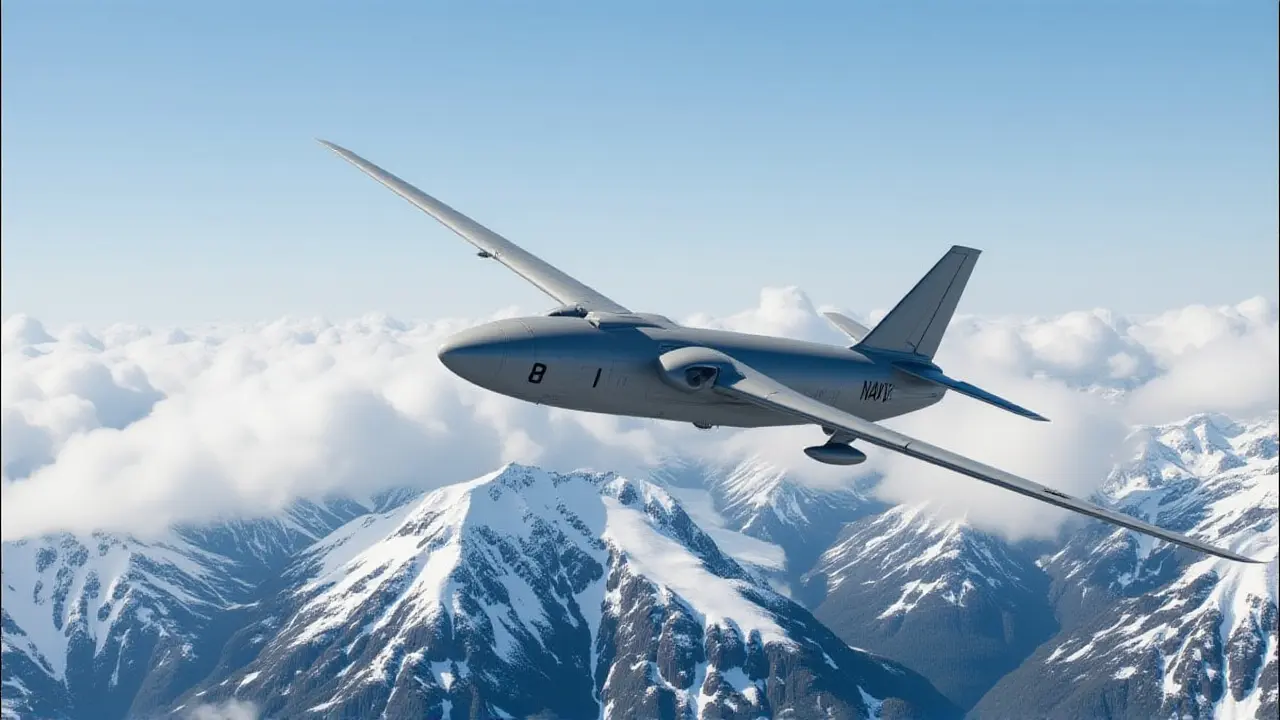
The US Navy just took a massive financial and operational hit after one of its most advanced surveillance assets, an MQ-4C Triton drone, plunged into the waters of the Persian Gulf on April 9, 2026. The loss, valued at roughly $240 million, was officially confirmed by the U.S. Naval Safety Command in a mishap report released on April 17, 2026. While no one was hurt—since the aircraft is uncrewed—the crash represents a significant gap in maritime intelligence capabilities in one of the world's most volatile regions.
Here's the thing: this wasn't just a routine technical glitch. The aircraft, identified as airframe 169804, vanished from tracking screens after a terrifying descent. It didn't just drift down; it plummeted from a cruising altitude of 50,000 feet to below 10,000 feet in what appears to have been a sudden, catastrophic failure. The drone was reportedly heading back to its home base at Naval Air Station Sigonella in Italy when the signal went dark.
A High-Stakes Emergency in the Sky
Flight data paints a grim picture of the final moments. Before the drone disappeared, it began broadcasting emergency transponder codes. First, it squawked 7400, which tells controllers that the aircraft has lost its connection with ground operators. Then, it switched to 7700—the universal code for a general in-flight emergency. It's the aviation equivalent of a distress flare.
Interestingly, the aircraft was last tracked in international airspace moving toward Iran. However, the Navy has been quick to clarify that there is no evidence the drone actually entered Iranian territory. The exact crash site remains a closely guarded secret, labeled under "OPSEC" (Operational Security). Turns out, the military doesn't want to reveal exactly where the wreckage lies, likely to prevent adversaries from recovering sensitive surveillance technology.
The Navy has classified this as a "Class A mishap." In military terms, that's the most severe category, reserved for accidents involving more than $2 million in damages or the loss of life. Given that this bird cost nearly a quarter of a billion dollars, it fit the criteria comfortably.
The Tech Behind the Loss: What is a Triton?
To understand why this loss hurts, you have to look at what the Triton actually does. Developed by Northrop Grumman under the Broad Area Maritime Surveillance (BAMS) program, the MQ-4C is essentially a high-altitude vacuum cleaner for data. It's designed to spend massive amounts of time in the air, scanning the horizon for ships, submarines, and coastal movements.
The heart of the machine is the AN/ZPY-3 Multi-Function Active Sensor (MFAS). This X-band radar is a beast; it can survey 2,700,000 square miles of ocean in a single 24-hour period. It doesn't matter if there's a storm or total darkness—the radar can pinpoint targets using an inverse synthetic aperture mode. When you pair a Triton with a Boeing P-8 Poseidon patrol plane, the Navy essentially owns the visual map of the ocean.
The loss of airframe 169804 is particularly stinging because the fleet is so small. As of 2025, the U.S. Navy only had 20 of these drones in service. Losing one means 5 percent of their total global surveillance fleet just vanished into the sea.
Strategic Implications and the 'Why'
The timing and location of the crash are what make this a headache for planners in Washington. The Persian Gulf and the Strait of Hormuz are some of the most contested waterways on earth. A gap in "eyes in the sky" can lead to intelligence blind spots that adversaries might exploit. But wait, the real question is: what caused the fall? Was it a mechanical failure, a software glitch, or something more sinister?
Industry experts are pointing to the sudden altitude drop as a red flag. A descent from 50,000 feet to 10,000 feet in a short window suggests a structural failure or a total loss of flight control. If this was a systemic issue with the Northrop Grumman airframe, the other 19 drones in the fleet might be at risk. The details are still unclear, and the Navy hasn't released a formal investigation report yet.
From a budgetary perspective, $238 million to $240 million is a staggering sum for a single lost asset. While insurance and government contracts cover the cost, the operational downtime is what the Navy can't afford. Recovering the wreckage is likely the top priority, though doing so in the deep waters of the Gulf is a logistical nightmare.
What's Next for the Triton Fleet?
Looking ahead, the Navy is still planning to acquire seven more aircraft to bolster the fleet. However, this incident will likely trigger a rigorous safety review of the existing MQ-4C units. We can expect more scrutiny on the link between ground control stations and the aircraft, especially given the 7400 emergency code reported during the incident.
For now, the military is keeping the specifics under wraps. Whether this was a freak accident or a sign of a deeper flaw in the BAMS program will determine if the U.S. accelerates its procurement of new drones or pauses to fix the ones it already has.
Frequently Asked Questions
What exactly is a Class A mishap in the US Navy?
A Class A mishap is the most severe category of military accident. It is defined as an event that results in an aircraft loss, a fatality, permanent disability, or damage exceeding $2 million. Because the MQ-4C Triton is valued at approximately $240 million, this crash automatically triggered the Class A designation.
Why was the crash location kept secret?
The Navy cited OPSEC (Operational Security) for withholding the location. This is standard procedure to prevent foreign intelligence agencies—particularly those in the region—from locating and recovering the debris, which contains highly sensitive radar and sensor technology developed by Northrop Grumman.
Did the drone crash in Iranian territory?
There is no evidence that the aircraft crashed in Iran. While flight tracking showed it was heading in the direction of Iran in international airspace before the signal was lost, the U.S. Navy has not reported any territorial incursions or claims of recovery by the Iranian government.
What do the transponder codes 7700 and 7400 mean?
Code 7700 is the international standard for a general in-flight emergency, signaling that the pilot (or operator) is experiencing a critical problem. Code 7400, in the context of uncrewed aircraft, is often used to indicate a loss of command-and-control link between the drone and its ground operators.
How many Triton drones does the US Navy have left?
As of 2025, the Navy had 20 MQ-4C Tritons in service. With the loss of airframe 169804, the active fleet has been reduced to 19 aircraft. To mitigate this loss, the Navy still intends to purchase an additional seven aircraft to expand its maritime surveillance capacity.

Vusumuzi Moyo
I am a journalist specializing in daily news coverage with a keen focus on developments across Africa. My work involves analyzing political, economic, and cultural trends to bring insightful stories to my readers. I strive to present news in a concise and accessible manner, aiming to inform and educate through my articles.
13 Comments
-
SAURABH PATHAK
April 19, 2026 AT 19:16Actually, if you knew anything about the BAMS program, you'd know that the link loss (7400) usually precedes the emergency descent. It's a failure of the C2 link, not some magic Iranian laser. The Navy is just playing it safe with the OPSEC because the sensor suite on the MFAS is way too sensitive to let some foreign intel team pick it up from the seabed.
-
Shelley Brinkley
April 20, 2026 AT 22:18240 mil for a flying toy that just falls over lol waste of tax money
-
Kartik Shetty
April 21, 2026 AT 05:04The sheer banal nature of these discussions is exhausting. We are witnessing the inevitable entropy of over-engineered systems where the cost of complexity outweighs the utility of the asset. A systemic failure is the only logical conclusion here
-
Dianna Knight
April 22, 2026 AT 05:34This is such a tough break for the fleet! 😰 Losing 5% of your global ISR capacity in one go is a huge blow to the operational tempo. Hopefully the safety review helps them pivot and optimize the C2 links so the rest of the birds stay flight-worthy! Keep your heads up, team! 🚀✨
-
Arun Prasath
April 22, 2026 AT 08:21It is important to note that while the financial loss is significant, the primary concern for the Naval Safety Command will be the telemetry data. If the aircraft transitioned from 7400 to 7700, it indicates that the onboard autonomous safety systems were attempting to manage the crisis after the ground link was severed. This distinction is critical for the subsequent root cause analysis.
-
Angie Khupe
April 23, 2026 AT 16:02I just hope everyone involved in the cleanup is staying safe! 🕊️ It's a lot of money, but peace and security are more important. 😊
-
Mel Alm
April 23, 2026 AT 21:32too bad they lost it in such a messy area. hope the navy dont let this escalate into sumthing bigger
-
saravanan saran
April 23, 2026 AT 23:19The ocean has a way of reclaiming everything eventually. Whether it's a million-dollar drone or a piece of driftwood, the depth of the Gulf reminds us how small our technological achievements are in the face of nature.
-
Priya Menon
April 24, 2026 AT 20:16The incompetence displayed in allowing a quarter-billion-dollar asset to simply "vanish" is absolutely abhorrent. One must wonder how many more of these "Class A mishaps" are being swept under the rug to maintain the illusion of military readiness. It is an utter disgrace to the taxpayers who fund these catastrophic failures.
-
Nikita Roy
April 26, 2026 AT 09:55they'll just build more better ones anyway no big deal
-
Jivika Mahal
April 26, 2026 AT 12:28oh wow that is a lot of money!! i bet the engineers are stressd out of their minds right now. hope they find the glitch soon so the others dont crash too!! 😱
-
shrishti bharuka
April 27, 2026 AT 05:48Oh wonderful, another multi-million dollar piece of scrap for the fish to enjoy. I'm sure the budget for the next seven drones will be perfectly managed and not at all wasteful. Truly inspiring work by the procurement office. 🙄


Write a comment
More Articles

How to Watch Heidenheim vs. Chelsea Live: UEFA Conference League Streaming Guide
Discover the ways to watch the UEFA Conference League clash between Heidenheim and Chelsea. Scheduled for November 28, 2024, this crucial match will be streamed on various platforms globally. Whether using Paramount+ in the US or other networks worldwide, fans can catch all the action live. Explore how VPNs can enable viewing from abroad and learn about each team's stakes in the league.

Jose Riveiro shuts down Bafana, Chiefs rumors
Jose Riveiro denies links to Bafana Bafana and Kaizer Chiefs, citing no formal offers. The former Orlando Pirates boss reflects on his trophy-winning legacy while preparing for a commercial tour in Johannesburg.

Diego Gomez perfect rating sparks Brighton's 6-0 demolition of Barnsley
Brighton thrashed Barnsley 6-0 in the Carabao Cup, with midfielder Diego Gomez earning a rare perfect score after a rapid hat‑trick. The win showcased tactical fluidity, defensive rigidity and attacking flair, signalling the Seagulls’ serious intent in the cup and the league.
Senthilkumar Vedagiri
April 19, 2026 AT 08:30lmao sure it just "plummeted" by itself... right before it was heading toward iran. sounds like some electronic warfare or a stealthy shoot down to me. the gov just says "mishap" so they dont start world war 3 over a fancy vacuum cleaner. wake up people!